
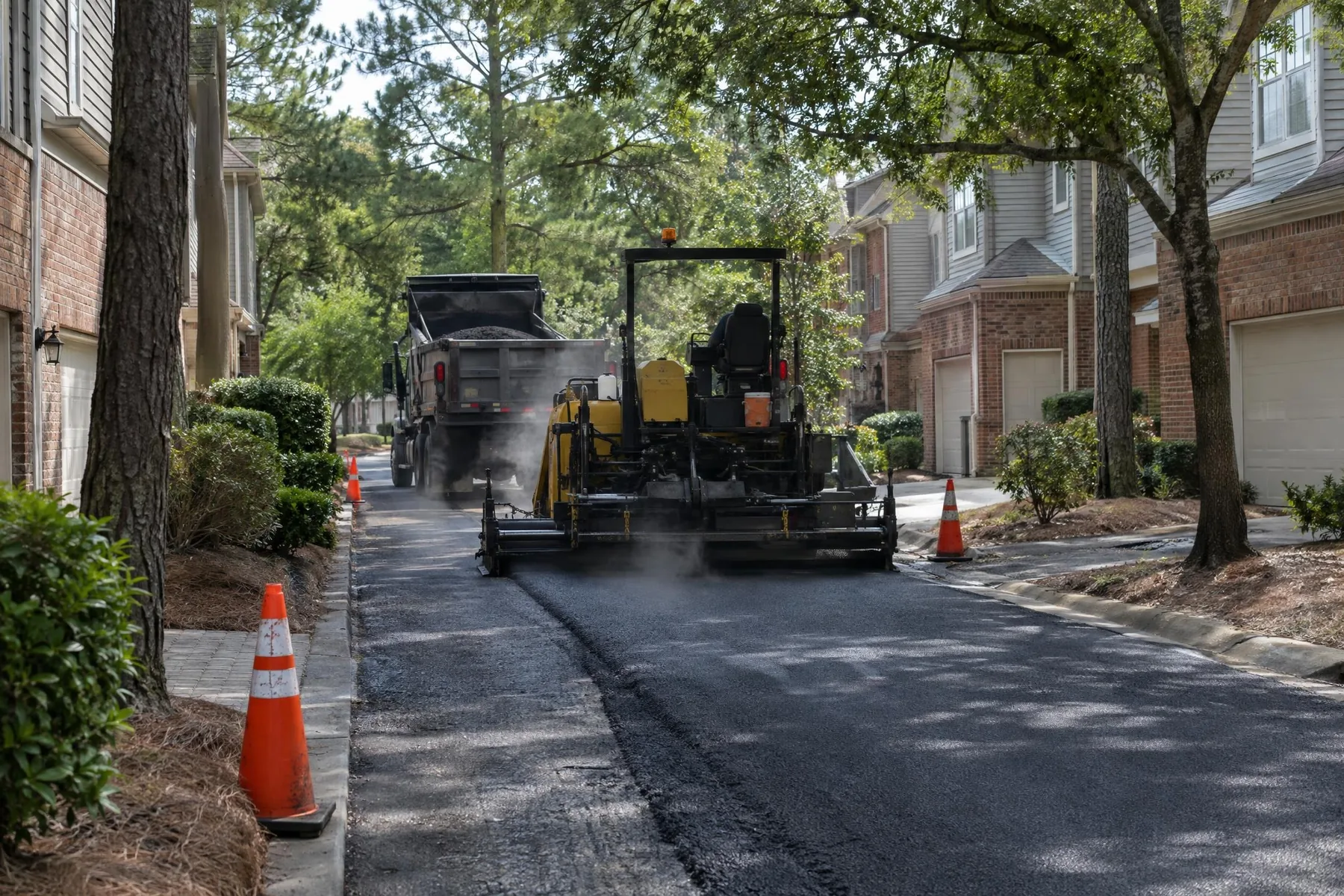
How Asphalt Paving Works: Why Smyrna Pavement Cracks First
Think of a paved surface as a sandwich. A bed of crushed stone, roughly four to eight inches deep, carries the load, and three to five inches of asphalt sits on top as the wearing layer. When water softens the stone, the asphalt flexes under each tire and splits wherever traffic runs hardest.
Smyrna’s ground makes that failure easier. County soil maps list Gwinnett, Madison, Appling, Pacolet, Musella, Cecil and Hiwassee series, and the city center sits on an urban land-Madison complex with gentle 2 to 10 percent slopes. Subsoil in the area holds 30 to 47 percent clay, and soggy clay hardly supports a bicycle, never mind a delivery truck.
Weather adds the final push. Roughly 50 inches of rain fall in a normal year with no truly dry month, and about 36 nights drop below freezing. Water slips into a hairline crack, turns to ice, pries the gap wider and repeats the trick all winter. A careful crew therefore invests more effort beneath the surface than on it, and the extra work shows up as extra years.